

From Side Hustle to Skill Stack
Why student gig work needs to move beyond delivery and towards employability

Hey, it’s Rohit. Happy Lohri/Makar Sankranti/Pongal/Magh Bihu!
Welcome to my weekly newsletter on elevating your career and enriching your lives.
In this week’s newsletter, we look beyond headline gig earnings to ask a tougher, more useful question: which student gigs actually build employability? It matters because income fades, but skills compound and the right early work can quietly shape an entire career.

Every few months, the gig economy gets a new headline. This time, it’s about students.
A recent LinkedIn News piece highlights how students across India are “fueling” the gig economy, earning anywhere between ₹6,000 to ₹15,000 a month. For many, especially in Tier-2 and Tier-3 cities, this income helps cover rent, food, or college expenses.
At first glance, it sounds like a win. Students earn early. Platforms get flexible workers. Everyone moves on.
But if we pause for a moment and look closer, the story feels incomplete.
The real question isn’t whether students are doing gig work. They are. The more important question is: what kind of gig work actually helps them build a future, not just survive the present?
This is where the current conversation needs a reset.
The Gap No One is Talking About
Most mainstream coverage lumps all gig work into one bucket. Delivery, telecalling, event staffing, data tagging, and content moderation. Same label. Very different outcomes.
Here’s what’s missing from the discussion.
1. Income is being measured, not impact
Earning ₹6–15k a month sounds decent, especially in smaller cities. But there’s no clarity on hours worked, volatility, or what happens when exams, health, or platform algorithms intervene.
More importantly, there’s no conversation about what students are learning while earning.
If a student spends two years doing delivery or repetitive telecalling, the income may help today, but their employability doesn’t move much tomorrow.
2. Skill-blind gig work creates a ceiling
Many gigs are transactional by design. Show up. Complete the task. Get paid. Repeat.
There’s no progression ladder, no portfolio, no narrative a student can later tell an employer beyond “I worked hard.”
Hard work matters. Skills matter more.
3. Platforms optimise for speed, not growth
Most gig platforms are built to reduce friction for clients, not to develop workers. Training is minimal. Feedback is rare. Skill pathways are almost non-existent.
The article celebrates participation, but avoids asking: participation in what kind of economy, and to what end?
A Better Question to Ask
Instead of asking, “How much are students earning through gigs?”
We should be asking, “Which gigs increase a student’s long-term value?”
This is where a quieter but more powerful shift is already underway.
The Rise of Employability-Focused Gig Work
Not all gig work is equal. A growing category of student gigs is doing something far more interesting: building transferable skills while generating income.
Let’s look at two that stand out.
1. Content optimisation and digital support
This is not influencer marketing. This is the unglamorous but highly employable backend of the internet.
Students are increasingly taking up work such as:
SEO-friendly content formatting
Blog updating and repurposing
Social media post optimisation
Newsletter editing and scheduling
Basic analytics reporting
Prompt-based AI content assistance
Why this matters:
These roles teach structured thinking, not just execution
Students learn how digital ecosystems work: search, attention, platforms
Work outputs are tangible and portfolio-ready
Skills transfer directly into roles in marketing, communications, product, and startups
A student who spends a year optimising content understands audiences, tools, deadlines, and feedback loops. That’s employability.
2. Research assistance and knowledge work
Another quiet shift is happening in research-heavy gigs.
Students are supporting:
Market and competitor research
Academic literature reviews
AI training data validation
Survey design and analysis
Policy, education, and business research assistance
This kind of work builds:
Critical thinking
Information synthesis
Writing clarity
Tool literacy (Sheets, Notion, AI tools, citation tools)
For students in Tier-2 and Tier-3 cities, these gigs are especially powerful because they are location-independent and mentally scalable.
A good research assistant today can become a consultant, analyst, strategist, or founder tomorrow.
Why These Gigs Are Different
Here’s what really separates survival gigs from employability-building gigs:
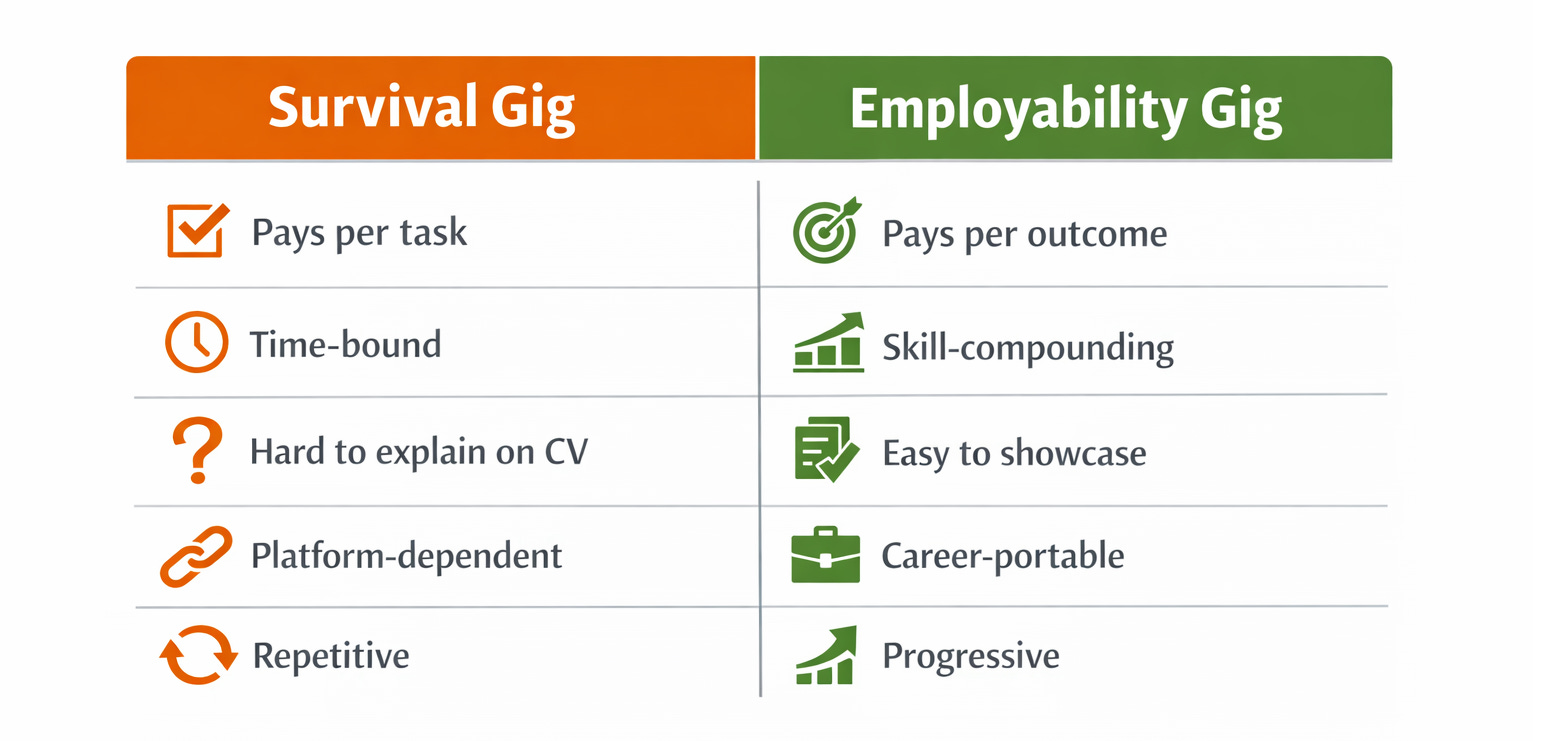
Survival gigs are mostly about completing tasks and getting paid. You show up, follow instructions, finish the job, and move on. The work is time-bound and repetitive, and once the shift ends, very little carries forward. It’s hard to explain this work on a résumé beyond effort and reliability, and your income stays tightly tied to the platform offering the task.
Employability-focused gigs work differently. They pay for outcomes, not just activity. Each assignment builds context, judgment, and capability. Over time, the work becomes easier to showcase because it leaves behind tangible proof: documents, analyses, content, and insights. These skills travel with you across roles, industries, and geographies. Instead of locking you into a platform, they expand your options.
What The LinkedIn Piece Gets Right, And How to Take it Further
To be fair, the article highlights something important: students are not waiting. They are entering the workforce early, experimenting, and taking responsibility.
That’s a signal worth paying attention to.
But to improve the condition of gig workers, especially students, three shifts are needed.
1. From access to pathways
Access to gigs is no longer the problem. Direction is.
Students need clarity on which gigs:
Build skills
Lead to better opportunities
Align with future roles
Career guidance must evolve to include gig literacy, not just placement prep.
2. From platforms to ecosystems
We don’t just need more platforms. We need ecosystems that include:
Training
Feedback
Mentorship
Skill progression
Imagine gig work where students can level up from execution to strategy. That’s where real value is created.
3. From income stories to capability stories
₹15,000 a month is a data point.
A student who can research, write, analyse, and optimise is an asset.
We should spotlight capabilities, not just earnings.
The Opportunity for Students in Tier-2 and Tier-3 Cities
Lower living costs mean even modest gig income goes further. When combined with remote, skill-based gigs, this creates a rare advantage.
Students don’t need to migrate immediately. They can:
Build portfolios from home
Work with global clients
Enter metros or corporate roles later with experience already in hand
This flips the traditional disadvantage narrative on its head.
The Elevate360: Elevating Careers, Enriching Lives perspective
At Elevate360, we look at work through a simple lens:
Does this increase a person’s options?
Gig work that only pays the bills limits options.
Gig work that builds skills expands them.
The future of student gig work isn’t about doing more tasks. It’s about doing better work that compounds.
If we get this right, the gig economy stops being a stopgap and starts becoming a launchpad.